Sunday

Easter templates

Free Easter templates for you to copy and use for craft: collage, colouring, cutting, cards, decorating at early play.  Simple egg shapes, chicks, bunnies, rabbits, carrots, baskets...
 

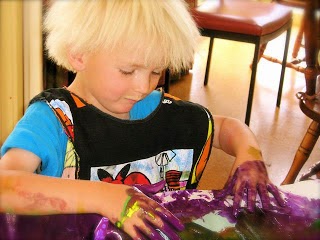
Finger Paint Printing

How to make finger paint prints
including a recipe for finger paint
at TODAY AT PLAY

Tuesday

Nature art inspired by Andy Goldsworthy

As a teacher or parent you need to know about Andy Goldsworthy, the British sculptor, photographer and environmentalist, to better appreciate your children's artistic creations.
nature art


Goldsworthy, has an OBE, a university degree and has written many books but basically I think he works and thinks like a preschooler when he is creating. He is like the child artist, that Picasso speaks of, before we crush them with our concepts of colour and materials and what we think equates as art.
1. The materials used in Andy Goldsworthy's art often include leaves, flowers, mud, pine cones, snow, stone and twigs. I have seen most children around the world use these materials to create.
2. Goldworthy also works in nature, outdoors, where the materials are found. Most children love to be outdoors and with the absence of plastic play equipment start to use found objects for play in the place where they find them.
3. Many of Goldworthy's creations are transient. They are photographed and left where they are created to alter and deteriorate. Preschool children enjoy the art of creating but rarely care if they take their art work home with them, or even look at it afterwards.

I am not saying we need to show these photographs of Goldsworthy's creations to children as I believe we just need to provide the natural materials. In many circumstances this may just mean taking the child/artist to the beach or the forest. As Goldsworthy says "Place is found by walking, direction determined by weather and season. I take the opportunity each day offers: if it is snowing, I work in snow, at leaf-fall it will be leaves; a blown over tree becomes a source of twigs and branches."

Here is some art created by children, outdoors using natural materials.


 Goldworthy in 2007: "I think it's incredibly brave to be working with flowers and leaves and petals. But I have to: I can't edit the materials I work with. My remit is to work with nature as a whole."

Picasso: "Every child is an artist. The problem is how to remain an artist once we grow up."

RESOURCES: Goldsworthy's site

rock artwork

Monday

Making a shekere

The shekere is an instrument from West Africa made from a dried gourd.  It has a net covering the gourd which is woven with beads.
It is used for folk songs and also in popular music. It is shaken and tapped against the hands.
If you do not have a dried gourd you can make a shekere using a plastic bottle.
We made ours with large plastic milk bottles which we painted in week 1 and left to dry.
The next week the children did dot painting on top of the paint.
They added a few dried beans and lentils into each bottle using a funnel - not too many.
Long colourful string was threaded with a bead and a knot, a bead and a knot, etc until about 8 beads on each of the 4 strands.
The children were very proud of their shekeres and used them at music time.

Friday

Shaving foam play


MATERIALS NEEDED:
  • shaving foam
  • large container or tray
  • aprons
  • food colouring (optional)
  • wash up area e.g.bucket of water
ACTIVITY:
  • Squirt a can of shaving foam into the tray - this is part of the fun, so let the kid's do it if they are capable of squeezing.
  • Put your hands in the shaving foam and start having fun.
  • After initial exploration you may like to add a drop of food colouring.
  • I love to do this activity outdoors, on a sunny day with kid's in their cossies so you can hose them off after they are finished with this sensory play.

Sunday

Cellophane paper collage

I think the picture says it all but...

1. It's coloured cellophane paper that you can see through when you hold it up.
2. It has been cut into random shapes and glued onto plastic mesh. The plastic mesh has been glued onto paper.
3. Some children did not want to use the mesh and glued their shapes onto paper.

Wednesday

Word for Wednesday

Laugh.
Sometimes it's good to just laugh, sometimes we all need to laugh. The friend of mine I admire most has a great sense of humour and always tells a great joke but seems natural doing it. He can diffuse any situation with a laugh. I wonder is that something he learnt and how?
Any way I think it is great for our children and us to just hang out, doing nothing in particular and maybe tell some jokes:
What is a mummy's favourite type of music? WRAP!
What did one elevator say to the other? I think I'm coming down with something!
What does the duck eat with his soup? Quackers!
(Thanks Ellen for the jokes)

Do you have any family favourite jokes?

Saturday

Creating a collage with bottle caps

We had a large collection of plastic bottle tops of all sizes and colours which we thought would fit nicely into our shapes around us theme.
Materials needed:
Plastic bottle tops
Thick cardboard or some other flat surface e.g. corkboard squares, the lid of a box...
2 sided tape (glue did not work very well)
Scissors - child safe ( or you could pre cut 2 sided tape in small widths to fit on back of bottle tops.)
Activity:
Children -
  • choose their plastic bottle tops
  • peel backing off 1 side of tape and place it on back of bottle top
  • peel backing off other side of tape and press it onto thick cardboard
  • create an amazinc, colourful collage of circles
A finished creation

    Look what other amazing creations from plastic caps we found:

Necklace of bottle caps

Music stick
at picklebums.com
Colour sorting and stacking

Lulu dot upcycles London’s waste into lasting beauty.
This is Captivative lamp, made from plastic bottle tops.

Paper cylinders and bottle caps could make many things...
Here at Learning 4 Kids they are turned into a stand up alphabet.

We have linked to Child Central Station which also has some more ideas for using plastic bottle tops and other recyclables in their What Would You Do With It? series.
Bottlecap Little BottlecapBottlecap Little Bottlecap: Four Art Projects for Children, Families, Schools and Non-Profits Utilizing Recycled Plastic Bottlecaps
by Michelle Stitzlein
30 page e book.
Four art projects using recycled, plastic bottle caps. Teachers and parents will enjoy this whimsical, colourful booklet that includes supply lists, step-by-step instructions and photographs for Lollipop Flower Lawn Ornaments, Polka Garden Installations, Cap-By-Number Murals and Mod Magnets for the fridge.

Bottle Cap Activities by Cathy Cisneros
From simple to sophisticated crafts, these innovatively creative projects are made of non-recyclable plastic bottlecaps. These free materials, when re-used into ingenious craft projects, are kept out of landfills and thus reduce pollution, which makes them a great lead-in for environmental science lessons -- or just for fun!  Activities include Bottlecap Barnyard, Bottlecap Band, a calendar of seasonal bottlecap crafts, and a variety of other fun environmental crafts.

Tuesday

Would you like to join our blog carnival?

The Word for Wednesday is ACTIVE.


It is easy to join the blog carnival?
Simply add a link to your post, about an active play idea for children, in ''Çomments".
The ideas will be included in a roundup in March. This time we are giving a prize - some books which will be suitable for early childhood to one lucky person who joins in and also "follows"this site.
You have until Wednesday March 7 to submit.
ac·tive
adjective
1. engaged in action; characterized by energetic work, participation, etc.; busy: an active life.
2. involving physical effort and action: active sports.
3. having the power of quick motion; nimble: active as a gazelle.
4. characterized by action, motion, volume, use, participation, etc.: an active group of toddlers.
Previous months Word for Wednesday contributors can be seen here.